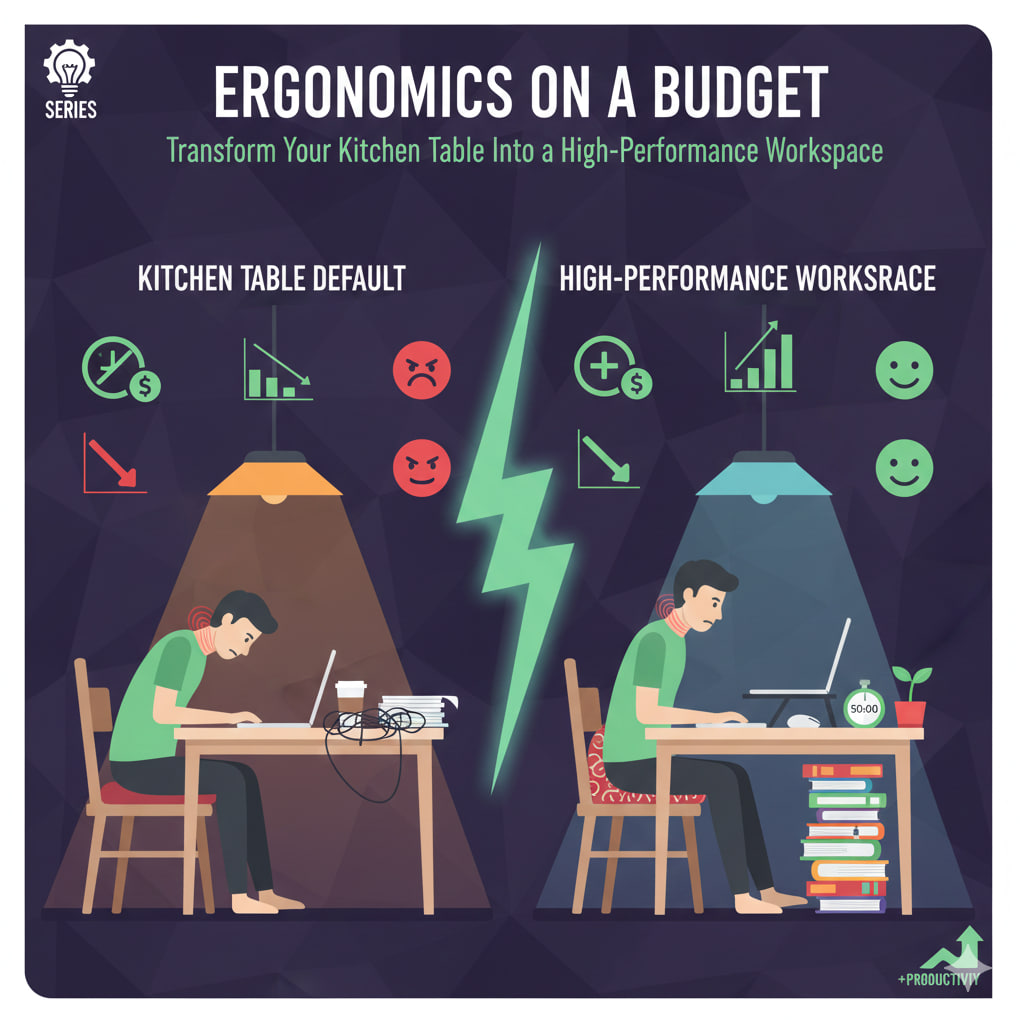
Ergonomics on a Budget: Transform Your Kitchen Table Into a High-Performance Workspace
By 2026, the “temporary” kitchen table office has become a permanent reality for millions. However, dining furniture is designed for eating, not for 8-hour spreadsheets. Most kitchen tables are 2–3 inches too high for ergonomic typing, and dining chairs lack the lumbar support needed to prevent “Tech Neck.”
You don’t need a $1,200 Herman Miller chair to fix this. You can build a pro-grade setup using items already in your pantry.
🪑 1. The “Dining Chair” Hack
Standard dining chairs are static and often too low. To achieve the 90-degree elbow rule:
- The Seat Boost: If your table feels too high (shoulders shrugging), sit on a firm decorative pillow or a folded wool blanket. Avoid soft bed pillows; they bottom out and kill your circulation.
- The Lumbar Roll: Take a medium-sized bath towel, roll it tight, and secure it with rubber bands. Place it in the small of your back. This forces your spine into its natural “S” curve.
- The Footrest: If you raised your seat, your feet might dangle. Use a sturdy shoebox or a stack of heavy cookbooks (looking at you, Joy of Cooking) to keep your feet flat. This takes the pressure off your lower back.
💻 2. The Eye-Level Laptop
Looking down at a laptop for hours is the #1 cause of cervical spine strain.
- The DIY Riser: Stack board games or Amazon boxes until the top third of your laptop screen is at eye level.
- The Mandatory Peripheral: Once your laptop is raised, you must use an external keyboard and mouse. Using a raised laptop’s built-in keyboard will cause wrist extension injuries (Carpal Tunnel).
- Budget Tip: In 2026, a basic wireless Logitech combo costs less than $25—cheaper than a single physical therapy session.
💡 3. Lighting & Vision
Kitchen lighting is usually “warm” and overhead, which causes screen glare and eye fatigue.
- The Window Rule: Position your table so the window is to your side, not in front of or behind you. This eliminates “backlighting” and direct glare.
- The 20-20-20 Rule: Every 20 minutes, look at an object 20 feet away for 20 seconds.
📊 The “Kitchen vs. Office” Specs
| Feature | Kitchen Table Default | Ergonomic Target | DIY Fix |
| Height | 30″ (Too high) | 27–28″ | Raise chair with firm cushions. |
| Back Support | 90° Hard Wood | 110° Recline + Lumbar | Rolled towel in lower back. |
| Monitor Pos. | 15° Downward Tilt | 0° (Eye Level) | Stack of books or boxes. |
| Foot Pos. | Danging/Tucked | Flat on Floor | Shoebox or “Foot Book.” |
🛠️ The 3-Minute “Reset”
Since you’re in the kitchen, use your appliances as productivity hacks. Set a kitchen timer for 50 minutes. When it dings, you are legally required to:
- Stand up and do 5 “Wall Slides” (flatten your back against a wall and slide down).
- Refill your water.
- Stretch your hip flexors (the muscles that tighten most from sitting in dining chairs).
The 2026 Reality: Your “workspace” is a mindset, not a piece of furniture. By adjusting your environment to fit your body—rather than forcing your body to fit the table—you’ll finish your Friday with a clear head instead of a stiff neck.
Leave a Reply