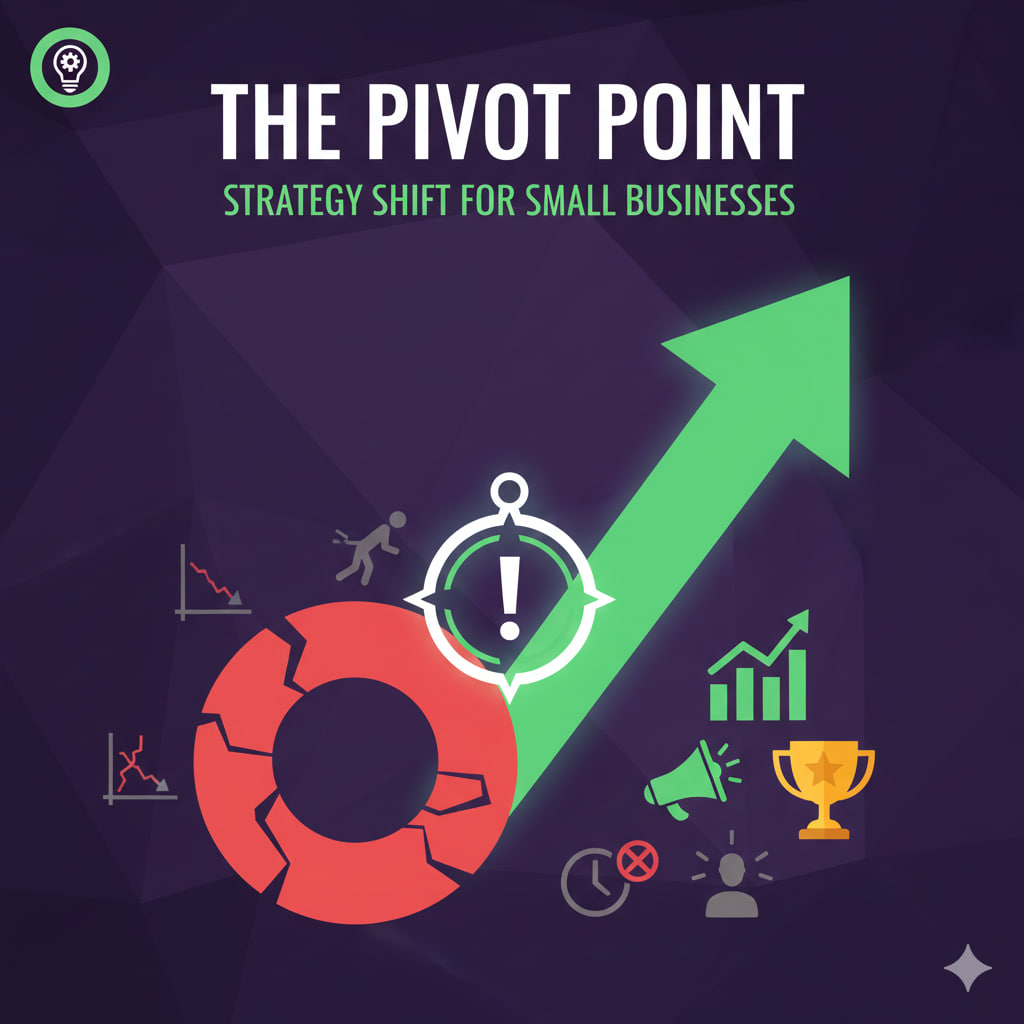
In the business world, “pivoting” isn’t just a buzzword; it’s a survival mechanism. A pivot occurs when a company shifts its business strategy to accommodate changes in its industry, customer preferences, or internal performance. It’s not an admission of failure—it’s an evolution based on data.
History is full of successful pivots: Slack started as a failed video game’s internal chat tool, and YouTube began as a video dating site.
🚩 5 Warning Signs You’re at the “Pivot Point”
Recognizing the need for change before your capital runs dry is the difference between a successful shift and a shuttered shop.
- Stagnant Growth Despite High Effort: You’re working harder than ever, but your revenue or user base has plateaued for 6+ months.
- High Customer Acquisition Cost (CAC): It costs you more to get a customer than that customer is actually worth to your business (LTV).
- The “Feature” is the Product: You notice your customers are only using one small part of your service and ignoring everything else.
- Market Shifts: A new technology or competitor has made your primary offering less “essential” and more “nice-to-have.”
- Employee Burnout/Disengagement: If your team no longer believes in the mission because the results aren’t following, the mission likely needs a refresh.
🛠️ How to Pivot Without Crashing
A pivot is a “change in vision, not a change in destination.” Here is how to execute it systematically:
Phase 1: The Post-Mortem
Analyze what actually worked. Use the Pareto Principle: identify the 20% of your activities that provided 80% of your results. That 20% is usually where your new direction lies.
Phase 2: The MVP (Minimum Viable Pivot)
Don’t rebuild the entire company in secret. Create a “lite” version of your new strategy and test it with a small group of existing customers.
Shutterstock
Explore
Phase 3: The “Kill Your Darlings” Stage
This is the hardest part. You must stop spending money and time on the old strategy. Keeping one foot in the old world and one in the new leads to “strategic drift,” which drains resources and confuses your brand.
Phase 4: Over-Communicate
A pivot can be scary for employees and investors. Be transparent about:
- Why the change is happening (show the data).
- What the new goals look like.
- How it benefits them in the long run.
💡 The Pivot Spectrum
Not every pivot is a total 180-degree turn. You might consider:
- Zoom-In Pivot: Focusing on a single feature of your previous product.
- Customer Segment Pivot: Selling the same product but to a completely different type of buyer.
- Channel Pivot: Changing how you deliver your value (e.g., shifting from a retail store to a subscription-based delivery model).
Leave a Reply